
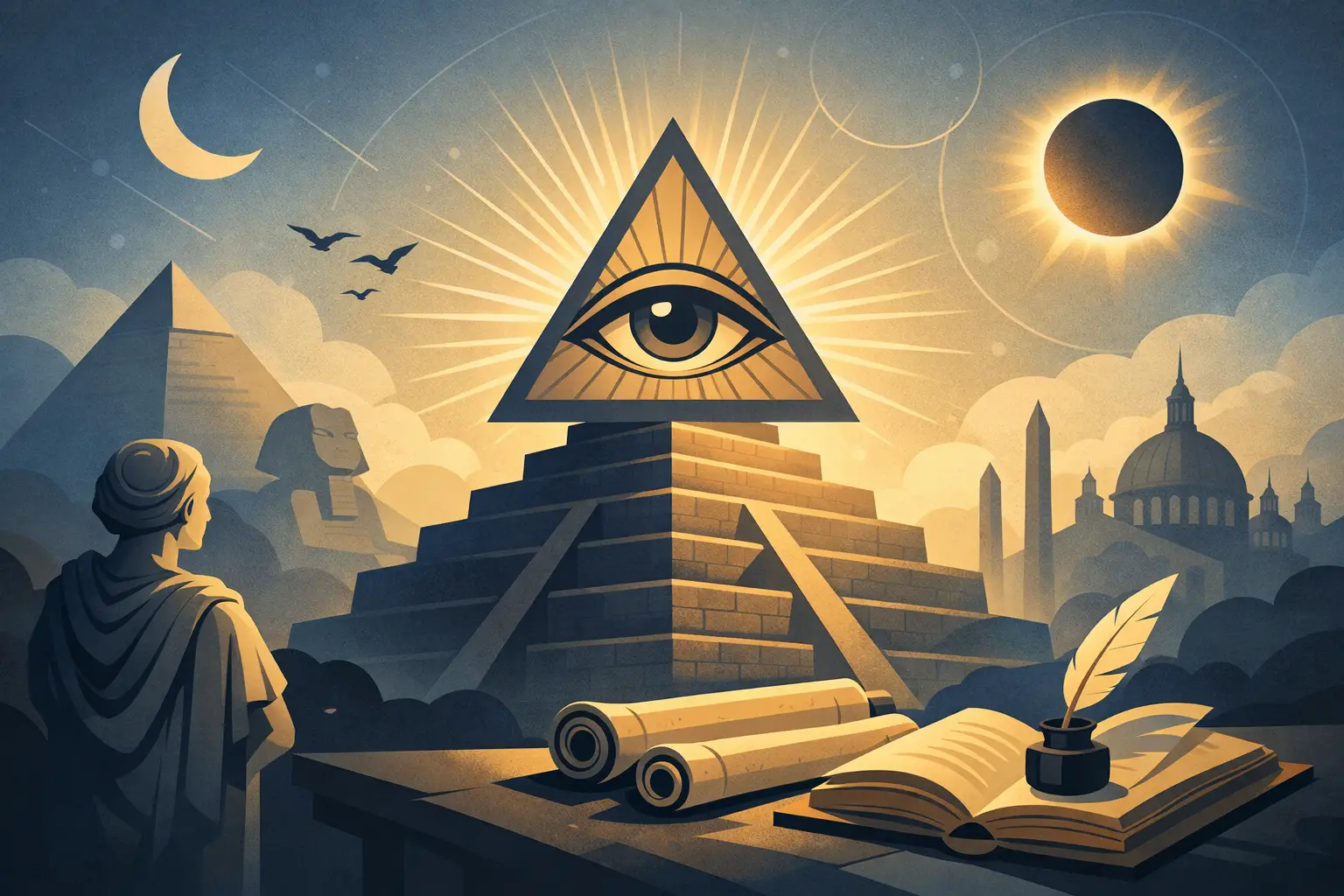
A name does not survive for centuries by accident. The origin of the illuminati continues to command attention because it sits at the crossroads of history, secrecy, power, and human ambition. For some, it is a footnote from the Enlightenment. For others, it is a symbol of hidden order – a circle of visionaries, strategists, and influential minds moving behind the visible stage of society.
To understand why the name still holds such force, you have to begin in Bavaria, in the year 1776. That date alone has helped elevate the legend. Yet the real story starts not with spectacle, but with intention.
The origin of the illuminati in 1776
The Illuminati began as a secret society founded on May 1, 1776, by Adam Weishaupt, a professor of canon law at the University of Ingolstadt in Bavaria. Weishaupt was a man shaped by the intellectual currents of his age. Europe was in the middle of the Enlightenment, a period that celebrated reason, inquiry, and resistance to oppressive authority. He believed many institutions, especially political and religious ones, held too much control over knowledge and thought.
His answer was not public revolt. It was selective organization.
Weishaupt created the Order of the Illuminati as a private network designed to cultivate disciplined thinkers who could challenge superstition, corruption, and blind obedience. The group was structured, hierarchical, and deeply intentional. Members adopted coded identities. Internal ranks shaped advancement. Secrecy was not a decorative element. It was central to how the order protected itself and strengthened loyalty.
That is one reason the origin of the illuminati has never been treated as ordinary history. From the beginning, the order presented itself as more than a social club. It was built as an initiated circle.
Why the founders chose secrecy
In the modern imagination, secrecy often suggests manipulation. In the eighteenth century, it could also mean survival. Bavaria was not a place where openly challenging religious or political orthodoxy came without risk. A discreet society gave members room to exchange ideas, build influence, and avoid direct confrontation.
There was also a second motive. Secrecy creates gravity. It separates the casual observer from the committed participant. A hidden order feels more serious, more selective, and more powerful than a public association. Even when its stated aims are intellectual, its structure sends another message: access must be earned.
That feature matters because much of the Illuminati’s legacy comes not only from what it believed, but from how it organized belonging. Initiation, advancement, coded knowledge, and layered status all contributed to the aura that still surrounds the name.
What the original Illuminati believed
The historical Illuminati did not begin as the all-powerful empire of popular myth. It was a reformist secret society with philosophical goals. Weishaupt wanted to reduce the influence of dogma, encourage rational education, and shape a better society through enlightened individuals. In principle, this made the group an expression of elite idealism.
Still, ideals and power rarely remain separate for long.
Any organization built around selective entry and internal hierarchy naturally attracts people who value influence. The Illuminati sought thinkers, professionals, and connected figures who could extend its reach. That did not make it omnipotent, but it did make it ambitious. The order wanted more than discussion. It wanted cultural penetration.
This is where history becomes more interesting than myth. The original society was neither all fantasy nor all domination. It was a real attempt to build a network of high-level participants around a shared vision of transformation.
The link between the Illuminati and Freemasonry
No account of the origin of the illuminati is complete without Freemasonry. Weishaupt understood that existing secret societies already possessed rituals, prestige, and influential members. Rather than invent every structure from scratch, he drew from Masonic models and sought to recruit within those circles.
This was a strategic move. Freemasonic lodges offered exactly what an expanding secret order needed – educated members, private meeting structures, and symbolic language that reinforced seriousness and identity. In some cases, the Illuminati used those existing frameworks to spread its influence more efficiently.
That overlap helped the order grow. It also helped feed suspicion.
When one secretive institution intersects with another, outsiders tend to imagine a much larger design. The historical facts show contact and borrowing, but the public imagination quickly transformed that contact into a vision of hidden control. That pattern has followed the Illuminati ever since.
Why the order was suppressed
The Bavarian Illuminati grew quickly for a brief period. Estimates vary, but it likely attracted several hundred to a few thousand members at its height. That may sound modest today, yet for a covert network in that era, it was enough to alarm authorities.
The government began to view secret societies as threats to public order. By the mid-1780s, Bavarian rulers banned the Illuminati along with other unauthorized secret groups. Raids exposed papers, correspondence, and internal documents. Weishaupt lost his position and went into exile.
Officially, this should have been the end.
And in one sense, it was. The original Bavarian Illuminati did not survive as a legitimate public institution moving continuously from 1776 to the present. That point matters if the goal is strict historical accuracy. But suppression also gave the group something far more durable than legal existence. It gave it myth.
A secret order shut down by the state does not disappear cleanly in the public mind. It becomes fertile ground for speculation. People begin to ask what was hidden, who escaped, what influence remained, and whether the visible end was only a veil.
How legend overtook history
The reason the Illuminati still dominates popular culture is simple. The historical order was real, but incomplete. It left enough evidence to prove it existed and enough mystery to keep interpretation open. That combination is powerful.
After the French Revolution, writers and polemicists began linking the Illuminati to far-reaching plots. Some claimed it had infiltrated political movements and engineered upheaval from the shadows. Others treated it as proof that hidden elites were directing nations. Over time, the name became less tied to Adam Weishaupt’s original program and more connected to a broader archetype – the invisible hand behind visible events.
This is where trade-offs matter. If you want the plain historical account, the Bavarian order was short-lived and relatively limited. If you want to understand why the name still commands fear and fascination, that plain account is not enough. The legend became larger because people are drawn to the idea that power is concentrated, concealed, and selective.
That belief is not unique to one era. It returns whenever institutions lose trust, whenever success seems inaccessible, and whenever the public senses that influence operates through private channels rather than open ones.
Why the origin of the illuminati still matters now
The Illuminati endures because it represents more than a single organization. It represents admission into hidden knowledge, proximity to power, and the promise that the world is shaped by circles most people never see. That is why the name resonates with entrepreneurs, artists, leaders, and seekers who feel that ordinary systems are too crowded, too shallow, or too controlled.
There is also a psychological truth here. People do not just want success. They want access. They want to believe there are gates, and that the right invitation changes everything. The mythology of the Illuminati speaks directly to that desire. It frames advancement not as random luck, but as selection.
This does not mean every modern claim attached to the name is historically verified. It means the symbol itself has evolved. For some, the Illuminati is still a cautionary tale about secret power. For others, it is a banner of elevation, unity, and disciplined ambition. The meaning depends on whether you approach it as a historian, a skeptic, or an aspirant.
A name that never truly disappeared
Names built on secrecy rarely vanish. They transform, gather new meanings, and reappear wherever influence and mystery meet. The original Illuminati emerged from Enlightenment Europe, from a founder who believed select minds could reshape society through hidden structure and strategic allegiance. Its formal life was brief, but its symbolic life proved far stronger.
That is the true force behind the name. The Illuminati was born in history, then reborn in imagination. Across generations, it came to stand for the eternal possibility that beyond ordinary systems there exists an inner circle – organized, protected, and set apart from the crowd.
Those who study the past will find a Bavarian secret order. Those who study power will notice something else. Every age creates its own version of the gate, the symbol, and the chosen few who step through it. Understanding that is where the story becomes personal.