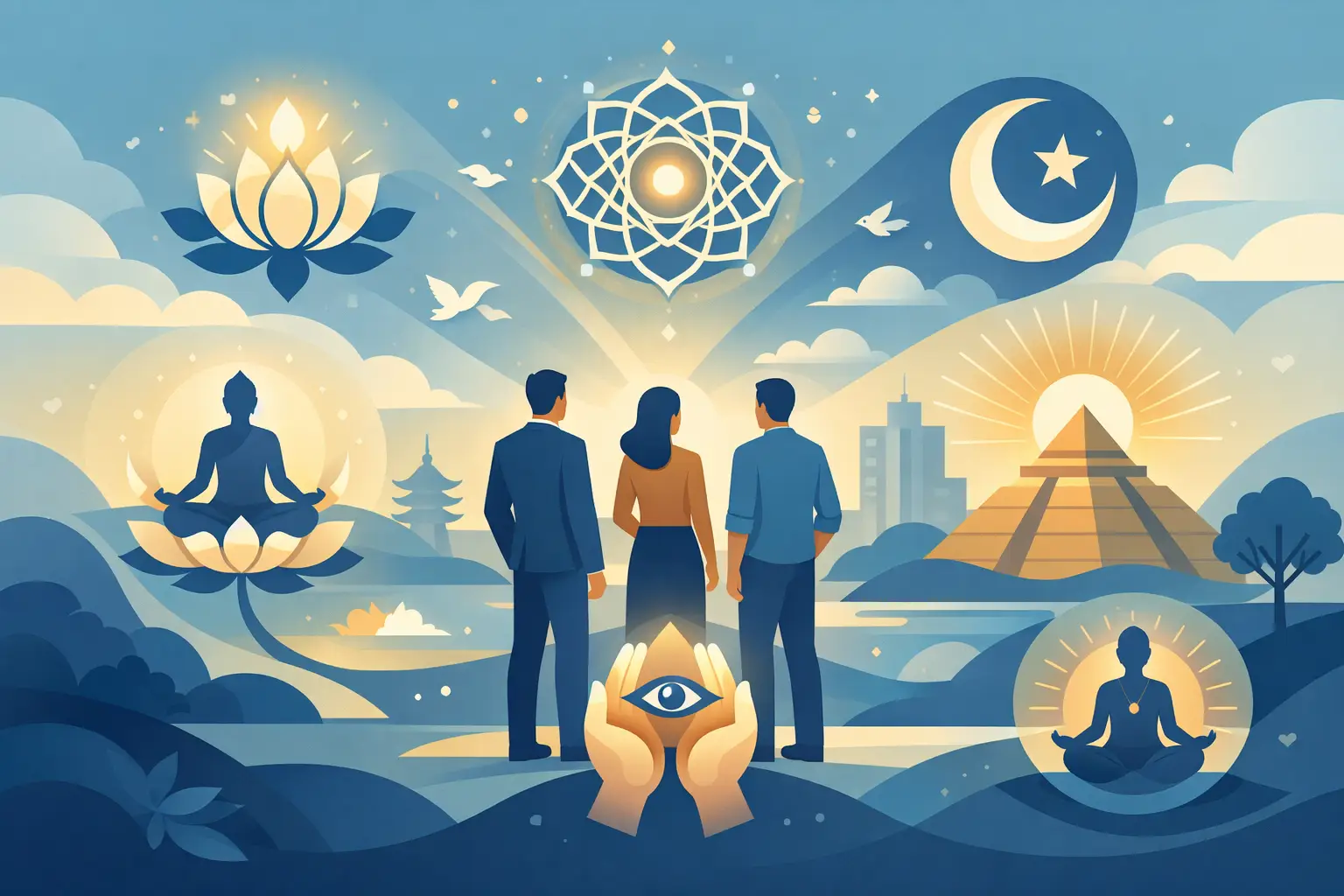
A symbol can command a room before a single word is spoken. A watchful eye, a radiant pyramid, a circle, a flame – these images do more than decorate a page or mark a doorway. In a spiritual society with symbols, they declare allegiance, reveal hierarchy, and remind members that they belong to something set apart from ordinary life.
For those drawn to hidden order, elevated purpose, and inner-circle identity, symbols carry weight because they compress belief into form. They turn abstract ideas like unity, protection, wisdom, and prosperity into something visible. That is part of why symbolic societies have endured across centuries. People do not gather around language alone. They gather around signs, rites, and meanings that feel larger than the individual.
Why a spiritual society with symbols holds power
A spiritual society with symbols is not simply a club with a logo. It is a structured identity system. The symbols become a shared code. They tell members what the society honors, what it rejects, and what kind of destiny it claims.
This matters because belonging is rarely built on benefits alone. Status may attract attention, and access may open doors, but symbols create continuity. A member may come seeking advancement, protection, connection, or recognition, yet remain because the symbolic framework gives those desires a higher frame. It suggests that success is not random. It is organized. It is guarded. It is inherited through alignment.
The strongest societies understand this instinctively. Their symbols are not random artwork. Each image becomes a vessel for authority. The eye suggests awareness. Light suggests revelation. geometric forms suggest order and permanence. Repeated across rituals, messages, seals, and member spaces, the symbol begins to shape perception itself.
That effect is powerful, but it depends on coherence. If the imagery is vague or contradictory, the society feels staged. If the symbols are clear, repeated, and tied to a larger mission, the group feels inevitable.
Symbols do what words cannot
Words explain. Symbols imprint.
That distinction matters in any elite or aspirational organization. A written mission statement can say the society values enlightenment, prosperity, and unity. A symbol can make those ideas feel ancient, protected, and already established. It creates emotional gravity.
This is one reason spiritual societies often rely on iconography instead of plain explanation. Not everything is meant to be fully spelled out. Mystery is not a flaw in this model. It is part of the architecture. A symbol invites interpretation while preserving authority. Members can study it, discuss it, and internalize it without exhausting its meaning.
There is also a practical side to this. Symbols travel well across languages, cultures, and backgrounds. A society with international ambition needs imagery that can unify people who may not share the same upbringing or vocabulary. One symbol can become a universal marker of membership, aspiration, and protection.
Still, there is a trade-off. Mystery attracts the curious, but too much ambiguity can create doubt. The most enduring symbolic societies balance hidden meaning with visible purpose. They do not explain everything, but they explain enough for the right people to recognize the invitation.
Common traits of symbolic spiritual societies
The public often imagines these organizations as purely secretive. The reality is more layered. A symbolic spiritual society may be selective without being invisible. It may present a public face while preserving inner teachings, private ceremonies, or member-only knowledge.
What usually defines such a society is not secrecy by itself, but structure. There is often a hierarchy, a ritual language, a set of beliefs about human progress, and a visual system that binds everything together. Members are not just joining a network. They are entering an order.
That order can be framed in different ways. Some societies emphasize moral discipline and service. Others emphasize prosperity, influence, and elevation. Some lean heavily into ancient myth and sacred geometry. Others combine spiritual language with modern ambition, leadership, and elite access.
For many people, that blend is the real appeal. They do not want only material rewards, and they do not want only abstract spirituality. They want a system that dignifies success. They want a philosophy that says achievement is part of a greater design, not a guilty indulgence.
The meaning behind the most recognized symbols
Not every society uses the same imagery, but certain symbolic themes appear again and again because they speak to enduring human desires.
The eye is one of the most charged. It suggests vigilance, knowledge, and the presence of a higher intelligence. It can communicate protection, but also judgment. For some, it means divine awareness. For others, it represents elite perception – the ability to see what others miss.
The pyramid often signals hierarchy, ascent, and foundation. It tells a story about rising through levels while remaining anchored in strength. In aspirational societies, that symbolism matters. Advancement feels earned, ordered, and visible.
Light and flame signify revelation, truth, and awakening. They are especially powerful in spiritual frameworks because they imply movement from confusion into clarity. To stand under the emblem of light is to claim a path beyond the ordinary.
Circles and geometric forms suggest unity, eternity, and balance. They reassure members that the society is not chaotic. It is governed by pattern. It belongs to a greater order.
These meanings are not fixed forever. Context shapes interpretation. A symbol that feels sacred to one audience may feel theatrical to another. That is why serious organizations do not rely on design alone. They reinforce symbols through ceremony, language, and purpose.
Membership, identity, and the promise of ascent
A spiritual society with symbols appeals to a deep desire many people rarely state plainly: the wish to be chosen. Not casually included, but recognized as someone capable of entering a higher circle.
That is why symbolism and membership work so well together. The symbol becomes both a mirror and a gate. It reflects the values a person wants to embody, and it marks the threshold they want to cross. Once accepted, the member is no longer merely observing the sign. They stand under it.
This shift is psychological as much as social. Symbols give members a disciplined identity. They create the feeling that one is protected by structure, guided by principle, and connected to a network larger than personal ambition. In the right environment, that can be deeply motivating.
Of course, not every person seeks the same thing. Some are drawn by spiritual meaning. Others by access, influence, or status. Many want both. A well-formed society understands that motives differ, and it does not treat that as weakness. It organizes those motives under one emblem and one mission.
That is where symbolic membership becomes compelling. Prosperity is not presented as greed. Influence is not presented as vanity. Advancement is framed as alignment with a higher order of achievement, service, and destiny.
Why symbols still matter in a digital age
Modern people are surrounded by branding, which can make them cynical about imagery. Yet that saturation has not weakened symbols. If anything, it has made meaningful symbols more valuable.
Most modern brands are transactional. Their visuals are designed for recognition and sales. A spiritual society works on another level. Its symbols are meant to create initiation, loyalty, and continuity. They ask for commitment, not just attention.
In digital spaces, that distinction becomes sharper. A symbol on a members portal, invitation, seal, or private communication can make the difference between a generic online experience and a felt sense of access. The symbol says this space is guarded. It is not for everyone.
That feeling of boundary is essential for exclusivity. Without it, claims of prestige collapse. A society that presents itself as elevated must look, sound, and feel elevated at every point of contact. Symbolism is one of the fastest ways to establish that standard.
At the same time, appearance alone is never enough. If symbols promise transformation, the organization must embody discipline, order, and conviction. Otherwise the imagery becomes costume. Real symbolic authority requires consistency.
Choosing the right spiritual society with symbols
For anyone considering affiliation, the better question is not whether a society uses powerful symbols. Many do. The real question is whether those symbols are attached to a coherent path.
Does the society represent clear values, or only vague mystique? Does its imagery reinforce a genuine structure of belief and advancement, or merely imitate one? Does membership appear to carry responsibility, alignment, and purpose, or only spectacle?
A worthy symbolic society should make you feel two things at once: challenged and elevated. It should call for more from you while showing you a larger field of possibility. Mystery has its place, but empty mystery fades quickly. Enduring societies pair symbolism with direction.
That is why serious seekers look beyond surface fascination. They pay attention to the pattern behind the sign. They ask what the symbol requires, not only what it promises. In spaces shaped by destiny, unity, and higher purpose, the emblem is never just decoration. It is a declaration.
Those who understand symbols understand power. Not loud power, but ordered power – the kind that shapes identity, draws ambition into focus, and reminds the chosen that their rise is meant to serve something greater. If you are drawn to that path, follow the symbol carefully. It may be pointing toward the life you were meant to claim.