
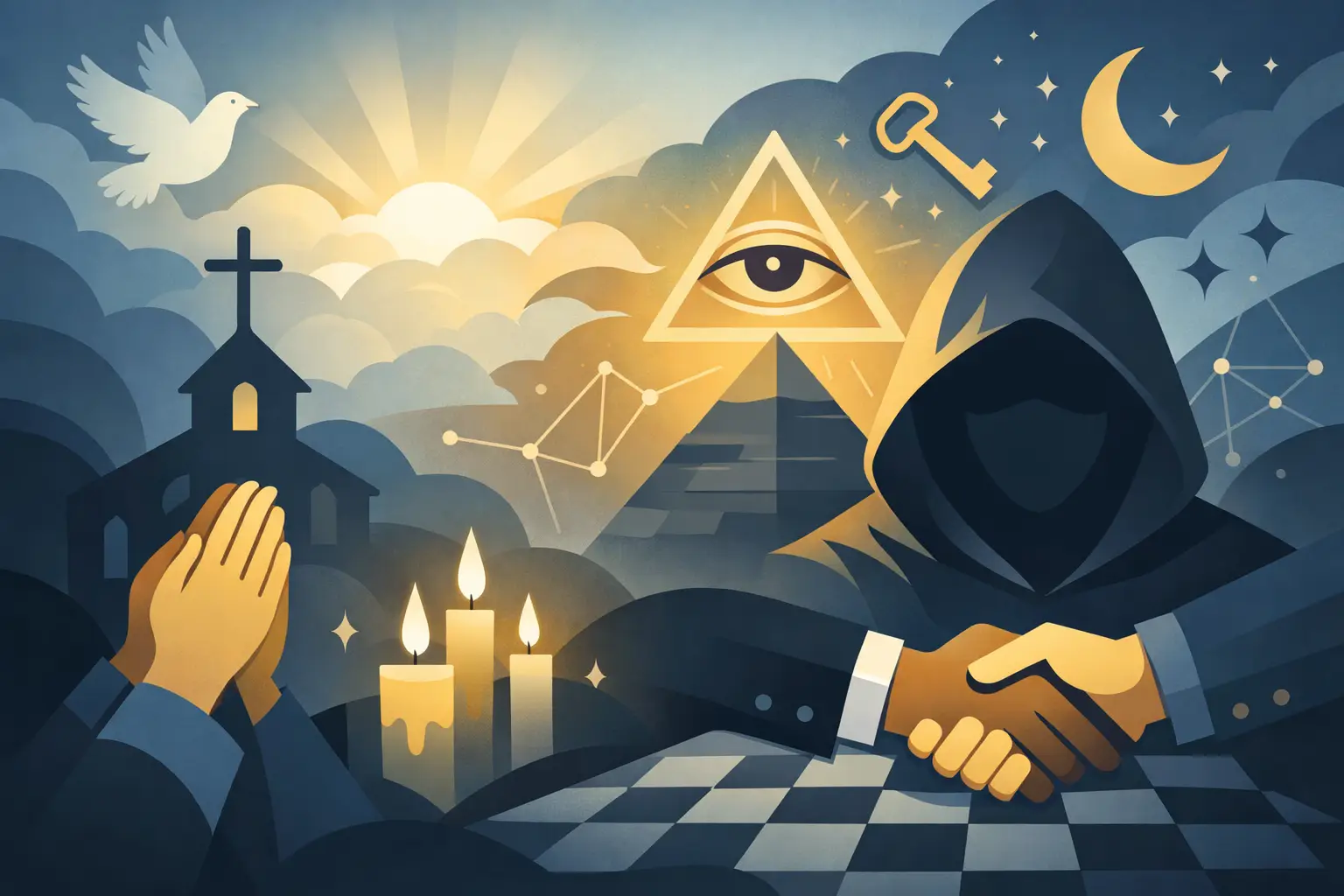
A person does not ask about faith and secret societies by accident. The question usually arrives at a threshold – after disappointment with ordinary institutions, after a growing fascination with symbols, or after the unsettling realization that power often moves behind closed doors.
That is where this subject becomes more than curiosity. It becomes personal. For many, faith is not limited to a church pew, a prayer book, or a doctrine inherited at birth. Faith is trust in a higher order. It is belief that life carries meaning, that destiny exists, and that some people are called to participate in purposes larger than themselves. Secret societies, in their highest form, appeal to that same instinct. They offer structure, symbolism, belonging, and the promise that hidden knowledge can elevate the worthy.
Why faith and secret societies are often linked
The connection between faith and secret societies is not simply about mystery. It is about initiation. Traditional faith communities use ritual to mark transformation. Secret societies do the same. One may call it baptism, ordination, covenant, or induction, but the pattern is familiar: a person enters one identity and emerges with another.
That shared structure matters because human beings crave more than information. They want meaning confirmed through action. A spoken creed can shape belief, but a symbol worn, a vow taken, or a rite experienced can shape identity. This is one reason secret societies have held such power in the public imagination. They do not merely teach ideas. They stage belonging.
There is also the matter of hierarchy. Most faith traditions recognize levels of spiritual maturity, responsibility, or insight. Secret societies often mirror that pattern through degrees, ranks, or circles of access. To outsiders, that may appear manipulative. To insiders, it can feel ordered, disciplined, and earned. The difference depends on the integrity of the institution and the intentions behind its structure.
Faith as a force of unity and destiny
Faith is often misunderstood as passive belief. In truth, faith has always organized people into movements, nations, and missions. It creates loyalty across distance. It gives sacrifice a purpose. It allows individuals to endure hardship because they believe they serve something eternal.
This is why ambitious people are drawn to spiritual frameworks, even when they distrust conventional religion. They do not reject transcendence. They reject empty forms. They want a belief system that speaks to power, discipline, protection, and destiny. They want to feel chosen without feeling controlled.
Secretive orders have long understood this desire. Their language often presents members not as consumers, but as stewards. Not as followers, but as guardians of a larger design. That message resonates with people who suspect that ordinary life is too small a container for their ambition.
Yet faith can elevate or distort. When belief is anchored in moral clarity, it becomes a compass. When belief is anchored only in ego, it becomes justification. That is the first real trade-off in this conversation. A society built around higher purpose can strengthen character. A society built around vanity can merely decorate it.
The symbolic power inside secret societies
One reason the public remains fascinated by hidden fraternities, orders, and elite circles is that symbols speak faster than explanations. A seal, an eye, a key, a pyramid, a ring, a robe, a coded phrase – these do more than decorate a group. They create an atmosphere of significance.
Faith traditions have always relied on symbols for the same reason. Symbols compress entire worlds of meaning into a single image. They remind members who they are, what they serve, and what is expected of them. In a fragmented culture, that kind of symbolic coherence feels rare and powerful.
This is where faith and secret societies overlap most clearly. Both understand that people do not live by facts alone. They live by narratives. They live by signs. They live by the conviction that what is visible is only part of the story.
For serious seekers, symbolism can be a doorway to discipline and insight. For the careless, it can become pure theater. That distinction matters. Not every mysterious symbol points to wisdom. Sometimes it points only to branding. The wise observer learns to ask what the symbol demands, not just what it suggests.
Faith and secret societies in modern culture
Modern culture treats secret societies in two extreme ways. It either mocks them as fantasy or inflates them into all-powerful machines. The truth is usually more complex. Some societies are little more than private networks wrapped in ceremony. Others are genuine communities of belief, mutual advancement, and long-term loyalty. A few become powerful because they combine both symbolism and strategic influence.
Faith plays a role in all of this because no durable society survives on incentives alone. Money attracts attention. Status attracts admiration. Access attracts ambition. But faith creates endurance. People remain loyal to a cause when they believe it stands for something sacred, historical, or world-shaping.
That is why elite organizations often speak in the language of mission, destiny, and protection. They know that material rewards without meaning feel hollow after a while. A private circle becomes far more compelling when it presents itself as part of a grand design.
For many aspirational individuals, this combination is irresistible. They do not only want opportunity. They want initiation into a worldview that explains why they were meant for more. The moment a society can frame advancement as both practical and spiritual, it gains unusual force.
When belief becomes dangerous
Not every fusion of faith and secrecy is noble. This subject deserves honesty. Secrecy can protect wisdom, but it can also hide exploitation. Faith can inspire service, but it can also be used to silence questions. Any group that demands total surrender while refusing accountability deserves scrutiny.
The warning signs are not always dramatic. They may appear as inflated promises, pressure to prove loyalty, or claims that all outsiders are blind, corrupt, or unworthy. A serious order may preserve privacy, but it does not need to prey on fear. A worthy circle may honor rank, but it does not need to erase conscience.
This is where discernment becomes essential. A person seeking a higher path should ask simple but difficult questions. Does this group call me to discipline or dependency? Does it expand my sense of purpose or merely flatter my ego? Does its secrecy protect a mission, or protect manipulation?
Faith without discernment becomes vulnerability. Secrecy without ethics becomes danger. The meeting point between the two must be governed by character.
What seekers are really looking for
Most people who become captivated by this world are not merely hunting for spectacle. They are searching for recognition, order, and alignment. They want to know that influence can serve meaning. They want to stand among people who carry themselves with intention. They want a path that feels set apart from ordinary noise.
This is why the subject endures across generations. Even in a secular age, the hunger remains spiritual. People still want to believe that the visible world is not the whole world. They still want access to circles where ambition is refined by ritual, where prosperity is framed as purpose, and where belonging feels earned rather than casual.
In that sense, faith and secret societies answer the same human ache from different directions. One says that truth is higher than the self. The other says access must be protected from the unworthy. When these ideas are aligned with wisdom, they can produce loyalty, dignity, and collective strength. When misaligned, they can produce illusion.
Some organizations understand this balance better than others. The most compelling do not offer mystery for its own sake. They offer a sense that advancement, symbolism, and unity are parts of one larger calling. That is why names associated with exclusivity, influence, and higher purpose continue to command attention in elite circles.
The deeper question behind faith and secret societies
The real question is not whether secret societies exist, or whether faith belongs in elite circles. The deeper question is what kind of person you become when you seek both.
If your pursuit is driven only by curiosity, you may collect symbols and gain nothing. If it is driven only by hunger for status, you may gain access and still remain empty. But if your pursuit is guided by purpose, discipline, and a willingness to grow, then hidden doors can become tests rather than distractions.
That is the standard that matters. Not every closed door conceals truth. Not every public institution lacks it. The challenge is to recognize where belief, power, and responsibility meet with honor.
For those called toward higher circles, the path should sharpen vision, not cloud it. Let your faith make you stronger, your questions make you wiser, and your ambition answer to something greater than applause.